


Post-Operative Physiotherapy
Helping your recovery following surgery
Helping your recovery after surgery
Medically reviewed by James Walker, Service Development Director & Senior Physiotherapist, on 21/07/26.
Recovering well from an operation rarely happens by rest alone. Post-operative physiotherapy gives your recovery structure - guided exercise and hands-on treatment that work alongside your surgeon's plan to ease pain and swelling, restore movement, and rebuild the strength you need for everyday life. We deliver it from our main clinic at Sandygate, Sheffield and across all 14 of our clinics in South Yorkshire, North East Derbyshire and Nottinghamshire, and you can book without a referral.
How much structured rehabilitation matters shows clearly in the evidence. After knee ligament (ACL) reconstruction, for example, most people get back to some form of sport and many return to their previous level, and how fully they recover is closely tied to the rehabilitation that follows the operation [1]. That is one example from one procedure, not a promise for every operation, but it underlines a consistent message: what you do after surgery shapes the result of the surgery itself.
What is post-operative physiotherapy?
Post-operative (post-surgical) physiotherapy is structured rehabilitation after an operation. It combines guided exercise and hands-on treatment to reduce pain and swelling, restore range of movement and strength, and rebuild day-to-day function. It works alongside the protocol set by your operating surgeon, so recovery is safe and progresses at the right pace for the procedure you have had.
Who is post-operative physiotherapy for?
Post-operative physiotherapy is for anyone recovering from an operation, most commonly orthopaedic surgery on the shoulder, knee, hip, spine, elbow, foot or ankle. It suits people of every age and activity level, from someone returning to daily independence after a joint replacement to an athlete working back towards sport. Self-pay, insured and privately referred patients are all welcome, and no referral is needed to book.
The aims of rehabilitation
Rehabilitation is planned around what matters to you and to your recovery. After assessing where you are, your physiotherapist sets goals and progresses them as you heal. The usual aims include:
- Reduction of pain and swelling
- Advice on scar management
- Restoring normal range of motion
- Strengthening weak muscle groups
- Improving day-to-day function
- Returning to normal hobbies and activities
- Answering any questions related to the rehabilitation process
What surgery can it help you recover from?
Post-operative physiotherapy supports recovery across a wide range of orthopaedic procedures. Below are common operations we help patients rehabilitate from, grouped by body region. Where we have a related condition page, it is linked for further reading - these cover the underlying problem rather than the surgery itself. If your procedure is not listed, we can still help; book an assessment and we will plan your rehabilitation around your surgeon's protocol.
Shoulder
- Sub-acromial decompression (related: shoulder impingement)
- Rotator cuff repair (related: shoulder pain and rotator cuff injuries)
- Labral repair
- Bankart repair (related: shoulder dislocation)
- Arthroscopic arthrolysis (related: frozen shoulder)
- Total shoulder replacement
Knees
- Total knee replacement (related: knee pain and injuries)
- Meniscal repair (related: meniscus knee tears)
- ACL repair (related: ACL and knee ligament injuries)
- PCL repair (related: knee ligament injuries)
Back and spine
- Discectomy (related: disc bulge and disc prolapse)
- Spinal fusion
Hips
- Total hip replacement (related: hip osteoarthritis)
Elbow
- Tennis elbow release (related: tennis elbow and golfer's elbow)
- Cubital tunnel release
Foot and ankle
- Ankle replacement
- Calcaneal osteotomy
- Achilles tendon repair (related: Achilles tendon pain)
- Ankle fusion
- Cheilectomy
- Hallux fusion
- Peroneal tendon repair
- Tibialis posterior tendon reconstruction
Whatever the operation, our role is the same: structured rehabilitation that helps you recover as fully and safely as possible. For more on the broader recovery pathway, see our page on post-surgery and fracture rehabilitation.
What does post-operative physiotherapy involve?
Your rehabilitation usually combines several approaches, chosen and progressed to suit your procedure and your stage of recovery.
Assessment
Recovery starts with a thorough assessment. Your physiotherapist reviews your operation and your surgeon's protocol, examines your movement, strength and pain, and agrees clear goals with you. This is also where the right timing and intensity for your rehabilitation are set, so the plan fits where you are rather than a generic timeline.
Manual therapy
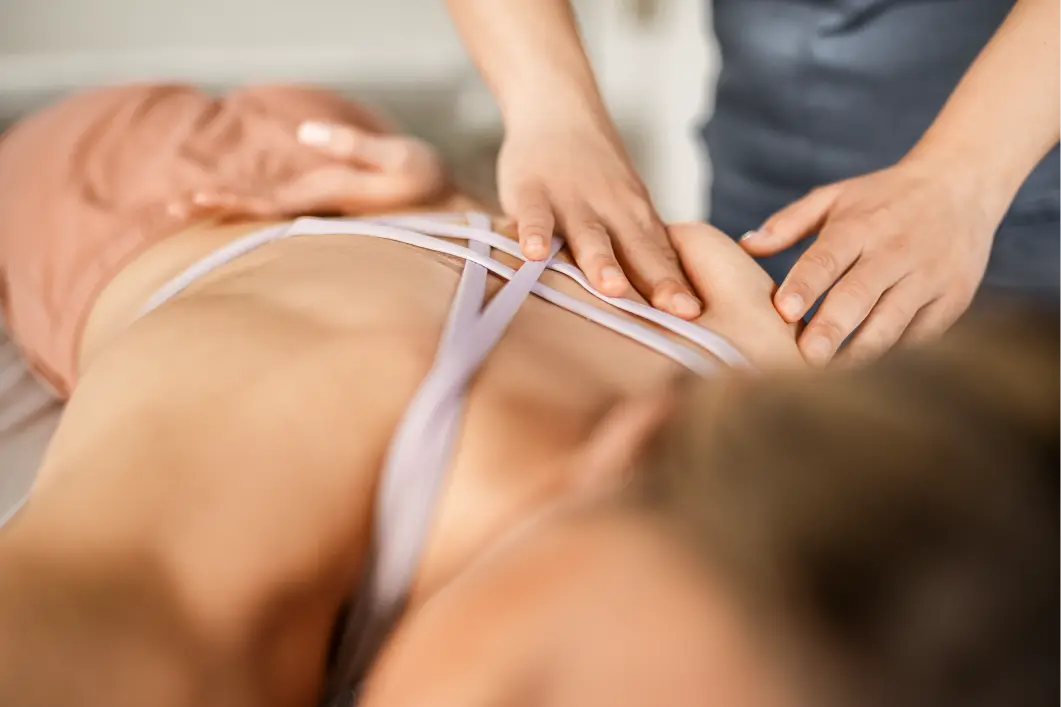
Hands-on treatment helps manage pain and swelling, ease stiffness, and restore movement around the operated area and nearby joints. It is used alongside exercise rather than instead of it, and is adapted to what your healing tissues can safely tolerate at each stage.
Progressive exercise rehabilitation
Guided, gradually progressed exercise is the core of recovery after surgery. Your physiotherapist builds a programme that rebuilds range of movement, then strength, then the control and function you need for daily life, work or sport. The programme advances as you do, always within the limits your surgeon's protocol allows.
Shockwave therapy
Shockwave therapy uses ballistic soundwaves to promote a regenerative and reparative response in muscles, bones and other tissues while providing pain relief. Where appropriate, it can support recovery and help some patients progress faster than exercise alone.
Blood flow restriction (BFR) training
Blood flow restriction (BFR) training involves specialised cuffs that partially restrict blood flow to a muscle during exercise. This can build strength using lighter loads, which is valuable after surgery when heavier loading is not yet safe. It is always applied selectively and under supervision.
Diagnostic ultrasound assessment
A physiotherapy assessment with diagnostic ultrasound scan images muscles, tendons, ligaments and joints in real time. A handheld transducer is moved over the area of interest, helping identify sprains, tears, strains, inflammation or degenerative changes that may be affecting your recovery.
When can I start physiotherapy after surgery?
When you can start depends entirely on your procedure and your operating surgeon's post-operative protocol. For some operations, gentle, guided rehabilitation begins within days; others need a protected healing period first. We do not set or change your timeline ourselves - we work to your surgeon's plan. The safest next step is to book an assessment so we can plan your rehabilitation around it.
Why have post-operative physiotherapy at the White House Clinic?
After surgery, the value is in rehabilitation that stays aligned with the people who operated on you. We are an established physiotherapy group with senior, experienced clinicians, and we have excellent working relationships with many of the leading orthopaedic surgeons in the area, so your programme follows your surgeon's protocol rather than working against it. Our physiotherapists rehabilitate the full range of orthopaedic procedures - upper limb, lower limb, spine, foot and ankle - and combine assessment, manual therapy and progressive exercise with shockwave, blood flow restriction training and diagnostic ultrasound where they help. Post-operative physiotherapy is available across all 14 of our clinics in South Yorkshire, North East Derbyshire and Nottinghamshire, so most patients can be seen close to home.
How much does it cost?
Post-operative physiotherapy is charged at our standard physiotherapy appointment rates, not a separate post-op price; see our prices page for current figures. These cover the initial assessment and follow-up consultations. If you are using private medical insurance or paying privately, our reception team can talk you through access before you book.
Book an appointment
You can book an appointment online or call our reception team on 0114 230 2030. No referral is needed. If you would prefer to talk through your recovery first, contact the team via our contact page and we will help you plan your next step.
This page is general information and not a substitute for individual assessment. Book an appointment or call 0114 230 2030 to speak to our team.
References
- Ardern CL, et al. (2014), Fifty-five per cent return to competitive sport following anterior cruciate ligament reconstruction surgery: an updated systematic review and meta-analysis including aspects of physical functioning and contextual factors. British Journal of Sports Medicine, 48(21):1543-52 - 81% returned to some kind of sport, 65% to their pre-injury level and 55% to competitive sport: https://pubmed.ncbi.nlm.nih.gov/25157180/
- NICE Quality Standard QS206, Statement 5 - Postoperative rehabilitation: https://www.nice.org.uk/guidance/qs206/chapter/Statement-5-Postoperative-rehabilitation


FAQs
How soon after surgery can I start physiotherapy?

How many physiotherapy sessions will I need after surgery?
The number of sessions varies by procedure and by individual, so we do not fix it in advance. After your assessment, your physiotherapist will give you a realistic idea of what your recovery is likely to involve and review it as you progress. Many people attend a planned course of sessions over their recovery.
Do I need a referral for post-operative physiotherapy?
No. You can book post-operative physiotherapy at the White House Clinic without a referral. If you have already been referred by a surgeon or consultant, that is welcome too, and we will work alongside their protocol.
Will you liaise with my surgeon?
Yes, where appropriate. We have excellent working relationships with many of the leading orthopaedic surgeons in the area, and we keep your rehabilitation aligned with your surgeon's post-operative protocol so your recovery stays safe and consistent.
Our Locations

Stay up to date with our regular advice articles and latest news


Our team are ready and waiting to assist with your recovery.


It depends on your procedure and your surgeon's post-operative protocol. Some operations allow gentle, guided rehabilitation within days; others need a protected healing period first. We work to your surgeon's plan rather than setting a timeline ourselves. Book an assessment and we will plan the right starting point with you.